

Healthy skin starts with accurate information. Many people now rely on digital tools to check their skin before choosing products or booking professional care. At the same time, dermatologists remain the trusted choice for diagnosing skin conditions and creating medical treatment plans. This raises an important question: How accurate is AI skin analysis compared to a dermatologist?
A modern skin analysis app can assess visible skin concerns in seconds using a smartphone camera and advanced image recognition technology. These apps provide quick insights into issues such as acne, pigmentation, enlarged pores, fine lines, redness, and oil balance. They also recommend skincare routines based on the results. While this technology offers convenience, it does not replace a clinical examination when medical attention is necessary.
The key difference lies in the purpose of each method. AI focuses on visual assessment and data-driven recommendations, while dermatologists combine visual examination with medical knowledge, patient history, and diagnostic testing. Both have important roles, and choosing the right option depends on your skincare goals.
This article explains how AI skin analysis works, how dermatologists evaluate skin, where each method performs well, and how they can complement one another.
How Dermatologists Assess Skin
A dermatologist relies on years of clinical training, direct physical examination, and tools built specifically for medical diagnosis. During a consultation, a dermatologist checks skin under different lighting conditions, sometimes uses a dermatoscope for magnified viewing, and asks about medical history, allergies, medication use, and lifestyle factors. This context matters because two people with similar-looking breakouts can have entirely different causes hormonal imbalance, a reaction to a product, or an underlying condition such as rosacea or eczema.
A dermatologist also factors in symptoms that a camera cannot capture: itching, pain, texture changes felt under the fingers, and how a condition has progressed over weeks or months. This clinical judgment is the reason dermatologists remain the standard for diagnosing and treating skin diseases, prescribing medication, and managing chronic conditions.
How a Skin Analysis App Works
A skin analysis app uses image recognition and machine learning models trained on large sets of facial photos. When a user submits a selfie, the app scans for visible signs such as acne, dark spots, redness, fine lines, oiliness, and pore size. The software compares these visual markers against its trained dataset and generates a report with a skin score and suggested next steps.
Speed and access are the biggest strengths here. A person gets results in under a minute, without booking an appointment or paying a consultation fee. For someone who wants a quick baseline reading, or wants to track how their skin changes over a few months, this kind of tool fits naturally into a daily routine.
Where Accuracy Holds Up: Surface-Level Detection
For visible, surface-level concerns, a well-trained skin analysis app performs close to human-level accuracy. Detecting acne lesions, uneven tone, visible pores, and fine lines is a pattern-recognition task, and modern computer vision models handle pattern recognition well. Several clinical studies comparing AI-based skin scoring to dermatologist grading have found strong correlation for these specific categories, particularly acne severity and pigmentation mapping.
This is also where a skin analysis app earns trust from users. A person does not need a medical opinion to confirm that a visible dark spot exists they need a fast way to measure it, track it, and act on it. Apps that partner with dermatologists for validation, rather than relying purely on automated grading, tend to close the gap even further, since a real clinician reviews the model's output during development and testing.
Where Accuracy Falls Short: Root Cause and Medical Nuance
The gap between an app and a dermatologist widens once the question shifts from "what does this look like" to "why is this happening." An app reads pixels. It cannot ask about a new medication, a recent stress event, a dietary change, or a family history of eczema. It cannot press on a lesion to check for firmness or feel for underlying inflammation. It cannot order a biopsy or a blood test when a rash suggests something beyond typical acne.
This matters because visually similar skin issues can have very different roots. A breakout pattern along the jawline might read as standard acne to an image model, while a dermatologist recognizes it as a possible sign of hormonal imbalance requiring different treatment altogether. A red patch might be flagged as "sensitivity" by an app, while a clinician identifies early-stage rosacea or a fungal infection that needs prescription treatment, not a serum.
Lighting, camera quality, and skin tone variation also affect app accuracy. Photos taken in yellow indoor lighting or with a low-resolution front camera can distort color readings, throwing off pigmentation and redness scores. Dermatologists control for these variables during an in-person exam; an app depends on the user to submit a clean, well-lit photo, and results shift when that input quality drops.
AI Skin Analysis vs. Dermatologist: Side-by-Side Comparison
The following comparison shows where each option performs best.
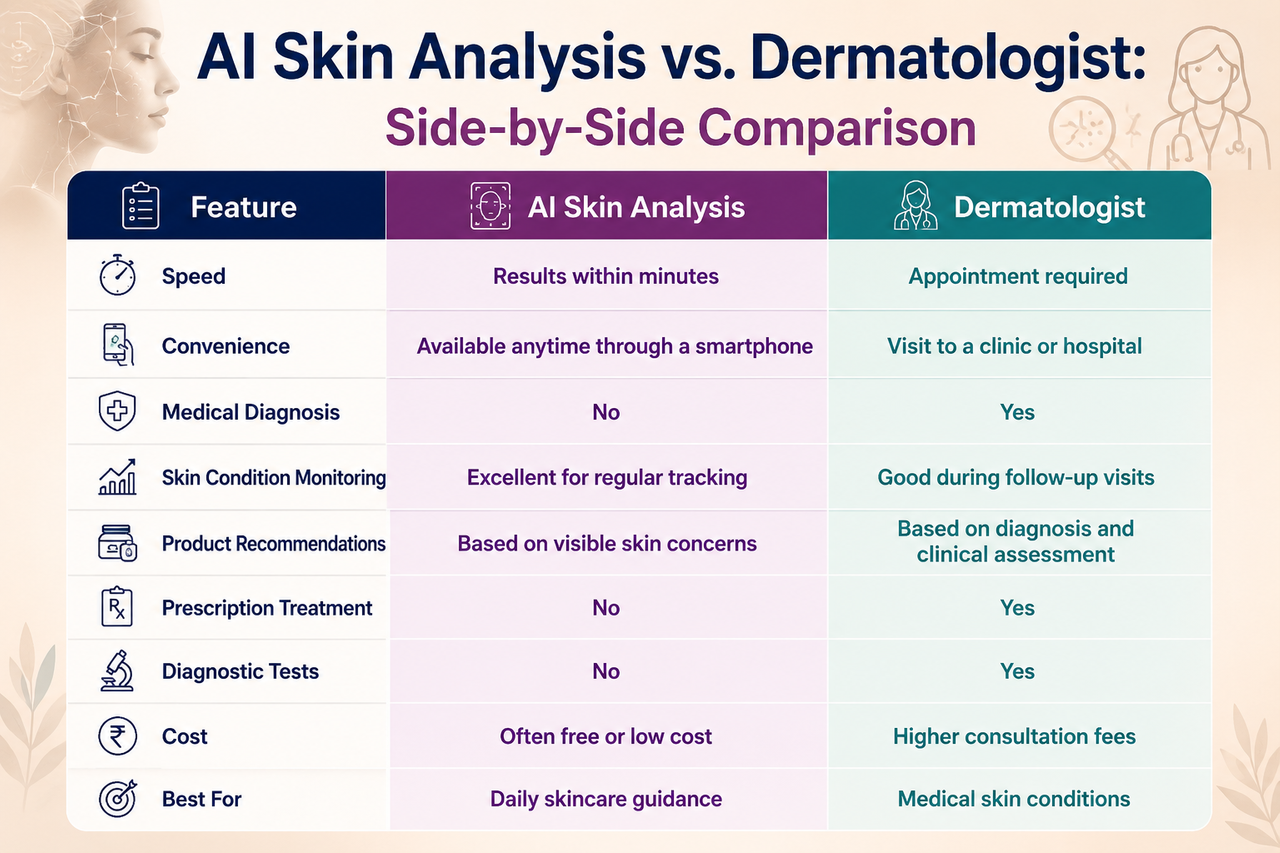
Both methods serve different purposes. AI supports everyday skincare decisions, while dermatologists diagnose and treat skin diseases.
A Side-by-Side Comparison
Speed: An app delivers a report in minutes. A dermatologist visit usually requires scheduling, travel, and wait time.
Cost: Most skin analysis apps offer free or low-cost scans. A dermatologist consultation carries a professional fee.
Depth of diagnosis: A dermatologist factors in medical history, physical touch, and follow-up questions. An app reads visible surface data only.
Consistency: An app applies the same scoring criteria every time, removing the subjectivity that can vary between different human graders. A dermatologist brings clinical judgment that adjusts for context an algorithm cannot see.
Best use case: An app suits routine tracking, product matching, and early awareness. A dermatologist suits diagnosis of persistent, painful, or unusual skin conditions, and any case involving prescription treatment.
Also Read: Post-Acne Pigmentation Explained
When to Trust the App and When to Book a Dermatologist
A skin analysis app works well as a starting point. It helps someone identify their skin type, catch early signs of a developing concern, and get matched with products that address a specific issue such as oiliness, enlarged pores, or dullness. Using an app consistently, say, once every week or two, also builds a visual history that shows whether a routine is actually working, something a single dermatologist visit cannot track on its own.
A dermatologist becomes necessary when a condition persists beyond a few weeks despite consistent care, when there is pain, swelling, or bleeding, when a mole or spot changes shape or color, or when over-the-counter products fail to produce any improvement. These are signals that the root cause may sit below what a camera can register, and only a clinical exam can confirm or rule out a medical condition.
Why the Two Methods Work Better Together
The most accurate approach does not pit AI against dermatology; it combines them. A skin analysis app gives a person a data point to bring into a dermatologist consultation, replacing vague descriptions like "my skin has been acting up" with an actual skin score, a photo history, and specific flagged concerns. This saves consultation time and gives the dermatologist a clearer starting picture.
Platforms like Skin-Pal build on this idea by pairing AI-based scanning with access to dermatologist input, rather than treating the scan as a final verdict. Skin-Pal's approach uses the scan to narrow down visible concerns quickly, then routes a person toward the right product category or professional consultation based on what the scan shows. This structure treats the AI layer as a screening step, not a replacement for medical care, which lines up with where the accuracy research currently stands.
Practical Tips for Getting Accurate Results from a Skin Analysis App
A few habits improve the reliability of any app-based scan. Take the photo in natural daylight rather than artificial indoor lighting, since natural light produces more accurate color and tone readings. Remove makeup before scanning, since foundation and concealer mask the exact concerns the app tries to detect. Keep the camera at the same distance and angle each time to make week-over-week comparisons meaningful. Use the same device when possible, since camera sensors vary between phone models and can shift readings.
Following these steps closes much of the accuracy gap tied to poor input quality, and gives the app the best chance to produce a report that matches what a trained eye would see.
The Technology Behind Accuracy Scores
Most skin analysis apps rely on convolutional neural networks trained on thousands, sometimes millions, of labeled facial images. Each image in the training set carries annotations marking specific concerns a dermatologist or trained grader has already identified: acne lesions, pigmented patches, and texture irregularities within that photo. The model learns patterns from this labeled data and applies the same logic to new, unlabeled selfies submitted by users.
The accuracy of any given app depends largely on three factors: the size and diversity of the training dataset, the quality of the labeling process, and how often the model gets retrained with new data. An app trained mostly on one skin tone or one age group will perform less accurately on users outside that range. This is why leading platforms continuously expand their datasets across different demographics and lighting conditions, and why third-party dermatologist validation during development matters more than marketing claims about "AI-powered" technology alone.
Some apps also add depth-sensing or multi-angle capture, asking users to submit photos from three or four angles instead of one. This reduces the blind spots that come from a single flat image and improves detection accuracy for concerns like pore depth and fine-line mapping, which are harder to judge from one flat photo.
Also Read: Why Are Pores So Big?
Common Misconceptions About AI Skin Diagnosis
A few misconceptions shape how people judge the accuracy of a skin analysis app, and clearing them up helps set realistic expectations.
Misconception one: AI scans replace medical diagnosis. No current skin analysis app is built or approved to diagnose medical skin conditions such as psoriasis, fungal infections, or skin cancer. These apps are designed for cosmetic screening flagging visible concerns like oiliness, acne, and pigmentation not for clinical diagnosis.
Misconception two: a higher skin score means healthier skin overall. A skin score reflects how the model rates visible surface conditions at that moment. It does not account for internal factors such as hormone levels, gut health, or sleep quality, all of which affect skin condition but are invisible to a camera.
Misconception three: one scan gives a complete picture. A single scan is a snapshot. Skin changes with weather, stress, diet, and hormonal cycles, so a scan taken during a stressful week may show more redness or breakouts than a scan taken a month later under normal conditions. Repeated scans over time give a far more reliable read than any single result.
What Dermatologists Say About AI Tools
Many dermatologists view skin analysis apps as a useful screening layer rather than a competitor. A quick scan gives a patient language and data to describe their concern accurately during a consultation, instead of a vague complaint about "bad skin." Several dermatology clinics now recommend patients track their skin with an app between visits, since the photo history shows how a prescribed treatment is performing over weeks, not just at a single follow-up appointment.
At the same time, dermatologists remain cautious about apps that present results as a final diagnosis rather than a screening tool. Skin conditions that mimic each other visually such as fungal acne versus bacterial acne, or eczema versus contact dermatitis need a trained eye and sometimes lab testing to tell apart correctly. An app that pushes a specific product based on a misread condition can delay proper treatment, which is why dermatologist-reviewed apps that flag uncertain cases for professional consultation tend to serve users better than apps that offer a product recommendation for every result.
Building Trust Between Users and AI-Based Skin Tools
Trust in a skin analysis app grows through transparency. Apps that disclose how their model was trained, whether dermatologists reviewed the scoring system, and what the tool can and cannot detect, give users a realistic view of accuracy from the start. Apps that avoid these details, or present every scan result as medically definitive, set expectations that the technology cannot currently meet.
A practical rule for users: treat a positive or reassuring scan result as useful information, and treat a concerning or unclear scan result as a reason to book a professional consultation rather than a final answer. This approach uses the app for what it does well: fast, consistent, accessible screening while reserving diagnosis and treatment decisions for a trained dermatologist.
The Bottom Line on Accuracy
An AI-based skin analysis app matches or comes close to dermatologist-level accuracy for visible, surface-level concerns such as acne, pigmentation, pore size, and fine lines, especially when the underlying model has been validated against real dermatologist grading. It falls behind when a condition requires medical history, physical examination, or diagnostic testing to identify the actual cause. Neither tool replaces the other completely an app offers speed, consistency, and daily accessibility, while a dermatologist offers clinical depth for anything beyond surface-level skin health.
For most people building a skincare routine, starting with a skin analysis app and following up with a dermatologist when a concern persists gives the most accurate and cost-effective path forward.
Get Your Skin Analyzed Today
A reliable skin analysis app gives a clear, fast starting point for anyone unsure about what their skin actually needs. Download the Skin-Pal app, run a free AI skin scan, and get a personalized report backed by dermatologist input. If your scan flags a concern that needs closer attention, book a consultation directly through the app and get matched with a dermatologist who can take the next step with you.
Download Skin-Pal now and get your first skin analysis report today.